Books I have read and recommend.

Saturday, January 11, 2014

PERRY Prussian Foot Artillery. 1813

 ABOVE: The Howitzer about to be fired and a gun being run up into the 'In Battery' position.
Hi All
Continuing on from my last post and  keeping with a 'Napoleonic' theme I recently finished off a 28mm Prussian Foot Battery.
The miniatures are PERRY. I've based them on 50mm wide by 100mm deep bases.
I'll use them for playing LASALLE and Field of Glory: Napoleon.
I'm a huge fan of PERRY MINIATURES. In 28mm scale I think only CALPE can rival their Prussian range.

There are 3 different types of poses with the PERRY Prussian Artillery. Firing, Loading and Running Up.

 BELOW: These guys are my favourites. As a Gunner myself I can really identify with these guys hauling their gun back it the 'In Battery' position in preparation for another shot. Maybe the next one will be for the devil,...


As usual comments are welcomed.
Cheers

Friday, January 10, 2014

Waterloo Highlanders: The 42nd Regiment of Foot

Hi Guys
A break from ACW stuff today and a look at something 'Napoleonic'.
Here is the freshly based 42nd Regiment of Foot, (The Black Watch) as painted by my very talented mate 'Gunner Dunbar'. They are almost all VICTRIX 28mm Plastics except for the Rude Highlander flashing his backside at those pesky French. He is a metal miniature from Westfalia Miniatures.
 
You can see the 'Hard Campaigning' Highlanders that Gunner Dunbar painted for me earlier HERE

I've included some regimental history notes as I found on Wikipedia.
Early History
After the Jacobite rising of 1715 the British government did not have the resources or manpower to keep a standing army in the Scottish Highlands. As a result, they were forced to keep order by recruiting men from local Highland clans that had been loyal to the Whigs. This proved to be unsuccessful in deterring crime, especially cattle rustling. Therefore Independent Highland Companies (of what would be known as the "Black Watch") were raised as a militia in 1725 by General George Wade to keep "watch" for crime. He was commissioned to build a network of roads to help in the task. The six Independent Highland Companies were recruited from local clans, with one company coming from Clan Munro, one from Clan Fraser, one from Clan Grant and three from Clan Campbell. These companies were commonly known as Am Freiceadan Dubh, or the Black Watch, this name may well have been due to the way they dressed. Four more companies were added in 1739 to make a total of ten Independent Highland Companies.
The ten Independent Highland Companies of "Black Watch" were officially formed into the "43rd Highland Regiment of Foot", a regiment of the line in 1739. It was first mustered in 1740, at Aberfeldy, Scotland. The Colonel was John Lindsay, 20th Earl of Crawford and the Lieutenant-Colonel was Sir Robert Munro, 6th Baronet. Among the Captains were his next brother, George Munro, 1st of Culcairn (also a Captain of an Independent Company raised in 1745) and their cousin John Munro, 4th of Newmore who was promoted lieutenant-Colonel in 1745 (in place of Sir Robert who went on to command the 37th (North Hampshire) Regiment of Foot). The other Captains of the 43rd were George Grant, Colin Campbell of Monzie, James Colquhoun of Luss, John Campbell of Carrick, Collin Campbell of Balliemore and Dougal Campbell of Craignish

 ABOVE: One of Westfalia's 'RUDE HIGHLANDER'.
 ABOVE and BELOW: My lads here are depicted as the would have appeared at Quatre Bras and Waterloo.


100 Days
The now single battalion 42nd fought at the chaotic Battle of Quatre Bras on 16 June 1815 and was one of four battalions mentioned in despatches by Wellington. Two days later at the Battle of Waterloo, the 42nd and also the 2nd/73rd Highlanders, were both in some of the most intense fighting in the battle and lost 289 men


I've based the miniatures on 50mm wide by 40mm deep bases for use with LASALLE or FOG-N.
Flags are from VICTRIX and come with the miniatures when purchased.
As usual comments are welcomed

Sunday, January 5, 2014

Introducing G.I. GINGER


Hi guys
My wife Raechel (G.I.Ginger) has entered in the Miss Pinup Australia contest in the NSW division
Raech is a serving member of the ADF. 
As you can see not all Army girls just wear army boots and spend all their time figuring out how to wrestle tanks.
Raechel's photos are inspired by the World War Two 'Rosie the Riveter' and Bomber Nose Art.


This link below takes you directly to 'G.I. Ginger's' photos:
 
 
You can see all the other NSW entrants here (you'll need to scroll down on the white page).
http://www.misspinupaustralia.com.au/index.php?page=nsw
 
Please vote for G.I. Ginger!
Serving in the Army and being married to a wargaming geek is reason enough to vote for her surely?
All the best for 2014.
Cheers
Scott

Friday, January 3, 2014

The 33rd Virginia Volunteer Infantry Regiment Emerald Guard


Hi Team
Today I'm posting about a Confederate Regiment, the 33rd Virginia Volunteer Infantry Regiment.
The regiment earned immortality at 1st Bull Run but I'm depicting them as they would have appeared at or after Gettysburg in 1863.
 ABOVE and BELOW: The 33rd advancing under fire.

As usual, they are based on 40mm square MDF with 'Golden Gel Medium' flocking paste (Coarse Pumice) which was coloured with 'Jo Sonjas' Burnt Sienna . The base was then dry brushed with Citadel 'Karak Stone' and finished with MiniNature grass tuffs and Army Painter Battlefield Grass.

The miniatures are mostly PERRY MINIATURES Plastics 'Confederate Infantry' but there are also a few PERRY, OLD GLORY 2nd EDITION and SASH AND SABER metals in there.
Flags are from FLAGS OF WAR.
I have based these chaps for playing LONGSTREET but they could easily work for BLACK POWDER or other rules.

As usual I obtained the following information from Wikipedia and checked it against my resources:

http://en.wikipedia.org/wiki/33rd_Virginia_Infantry


33rd Virginia

The regiment was organized and mustered into service soon after the secession of Virginia on 17 April 1861. It was formed of ten companies, which included men from Hampshire, Shenandoah, Frederick, Hardy, Page, and Rockingham counties. Two of these counties, Hampshire and Hardy, seceded in 1863 from the state of Virginia, forming part of the northeastern Panhandle of West Virginia.

The ten companies were:

1.A - Potomac Guards (Hampshire Co.)

2.B - Toms Brook Guard (Shenandoah Co.)

3.C - Tenth Legion Minute Men/Shenandoah Riflemen (Shenandoah Co.)

4.D - Mountain Rangers (Winchester, Frederick Co.)

5.E - Emerald Guard (Shenandoah Co.)

6.F - Independent Greys/Hardy Greys (Hardy Co.)

7.G - Mount Jackson Rifles (Shenandoah Co.)

8.H - Page Grays (Page Co.)

9.I - Rockingham Confederates (Rockingham Co.)

10.J - Shenandoah Riflemen(Shenandoah Co.)

 Originally, the regiment was commanded by Col. Arthur C. Cummings, though it would change hands many times through the war. The 33rd, along with the 2nd, 4th, 5th, and 27th Virginia Regiments, formed the famous 'Stonewall Brigade' under the command of the legendary Stonewall Jackson. The average height of a soldier in the regiment was 5'8", and the average age was 25 years; these figures fluctuated greatly as the years progressed.
 ABOVE and BELOW: I've based the 33rd as a big 10 base unit. Confederate units tended to be larger than their Federal counterparts on the whole.

 ABOVE and BELOW: All ten bases in line.
 
Action at 1st Bull Run (1st Manassas)

When the Union and Confederate armies engaged near Manassas Junction, Virginia on 21 July 1861, General Jackson and his brigade earned the nickname "Stonewall" when, as they retreated to reform along Henry House Hill, Gen. Barnard Bee cried out to his ailing troops: "There stands Jackson like a stone wall. Rally behind the Virginians!" Eight of the ten companies in the 33rd were present.

At the height of the battle, it was Jackson's first brigade, and more specifically, the undersized regiment of Colonel Cummings that turned the tide of battle with a well-timed charge against an exposed artillery battery. The successful capture of the guns is thought to be largely because, due to the lack of formality in early war uniforms, Jackson's men were dressed in blue, just like their Federal counterparts. Though the 33rd Virginia succeeded in capturing the guns, the number of men that made the charge (only about 250) were unable to maintain possession and were forced to retreat. The charge had halted the steady advance of the Union Army up to that point, and precipitated further charges by Jackson's other regiments. By day's end, the actions of the 33rd led to the complete rout of the Union Army, and played a major role in immortalizing the brigade.

The cost of immortality for Cummings' regiment was high. Of the 450 men who were present at the battle, the 33rd would suffer 43 killed and 140 wounded

The 33rd Virginia remained in the Stonewall Brigade in Thomas J. Jackson's Second Corps until the restructuring of the Army of Northern Virginia after his death in the spring of 1863. It was then put under Richard Ewell's command until the spring of 1864, when it dissolved at the Battle of Spotsylvania Court House.


Action at GETTYSBURG

Arriving late in the evening of 1 July, the brigade to which the 33rd belonged spent much of the second day skirmishing on the far Confederate left. It would not be until the next day that the 33rd would see real fighting. At 3:00 a.m. on the morning of the 3rd, the regiment was aroused and marched off with the rest of the brigade towards the enemy position atop Culp's Hill. After daybreak, the regiment advanced in line of battle towards the enemy who was "strongly intrenched in a most advantageous position." The regiment advanced up the slopes of the hill advancing "in intervals" as the men took cover behind rocks and trees as they advanced. Although the regiment exhausted its ammunition within an hour or two, at least part of the 33rd remained engaged for almost five hours, as partial supplies were received upon the field. During this portion of the fighting, Captain Bedinger of the Emerald Guard was killed while advancing towards the enemy. Captain Golladay, in temporary command of the regiment after the battle would write that Bedinger's body had fallen perhaps the closest to the enemy's lines.

Sometime around noon, the regiment was withdrawn from the slopes, reorganized and replenished with ammunition. The regiment was then moved several hundred yards to the right, and another advance was made upon the enemy. The fighting was intense and lasted only a half-hour or so before the regiment was withdrawn again and marched to the rear for a short rest until mid-afternoon. Again, the regiment was aroused, reequipped and marched to a position farther to the right of the line. From this time until nightfall, the regiment was only engaged in skirmishing after which the day's survivors quietly retired. Upon the field were left many whom Golladay considered the "flower of the regiment." Twenty-three percent of the 236 men who fought at Gettysburg were killed, wounded, or missing.

On 3 July, the Stonewall Brigade lost one of its former commanders, Richard B. Garnett, who was killed during the infamous 'Pickett's Charge,' possibly due to an injured leg that cause him to ride a horse into the battle.

As Lee began his long retreat in the rain on 4 July and 5, five members of company E, some of whom had been wounded two days before, were captured at Waterloo and Chambersburg. By the time the 33rd had re-crossed the Potomac and moved into camp around Orange Court House, the regiment numbered only 90 men. With the death of George Bedinger and the only Lieutenant, Patrick Maxwell, absent sick, Captain D. B. Huffman of Co. G, 33rd Virginia Infantry assumed temporary responsibility for the shattered Emerald Guard. On 31 August 1863, the 33rd was again mustered to be paid.

Thursday, January 2, 2014

Red Legged Devils: Part Two

Hi Guys
I've finished basing my PERRY MINIATURES 14th Brooklyn Infantry.
I use 'GOLDEN GEL MEDIUMS' and at 28mm scale opt for the Coarse Pumice Gel. This comes as a white paste which I like as I can colour it to suit. It's coarse enough to really take a dry brushing really well. After painting and dry brushing I added some grass 'Tuffs' and a few twigs I hunted around for in the garden. Finally I applied some ARMY PAINTER 'Battlefields Field Grass'. I highly recommend the ARMY PAINTER grass. It's very fine and 'sits up' nicely after being applied.
The Bases are 40mm square MDF bases from Back-2-Basix.
Flags are from FLAGS OF WAR.
Now I just need to start work on the Forgotten and Glorious miniatures version of this Regiment advancing at Right Shoulder Shift.

Comments are always welcomed.
Cheers

11th New York Infantry. The Fire Zouaves

Hi Guys
Continuing on with my ACW units in 28mm for 'LONGSTREET' I thought I'd share some photos on another unit that was baptised with fire at 1st Bull Run.
The 11th New York Infantry Regiment is another very colourful Regiment and like many of the early war Regiments looks and sounds more like a Social Club rather than a Infantry Regiment. Drawn from the ranks of the city's many volunteer fire companies, the unit was known alternately as the Ellsworth Zouaves, First Fire Zouaves, First Regiment New York Zouaves, and U.S. National Guards!
I used the very tasty PERRY MINIATURES codes ACW57 and 58. Flags are from FLAGS OF WAR
I purchased enough to make a six based unit. I'm kicking myself, as with gust 12 more miniature (2 packs) I could have created a big 10 base unit. Oh well, you live and learn and I've come up with a bit of a solution if I do need the extra four bases.
 As usual I've obtained some unit details / historical notes via Wikipedia. Not the best of accurate source I know, but I've check the facts against my own readings and they match up. Getting the details from Wiki just saves me a lot of time and hassle typing:

The 11th New York Infantry Regiment (Fire Zouaves).

http://en.wikipedia.org/wiki/11th_New_York_Infantry

The Zouaves' first major combat experience occurred during the First Battle of Bull Run. On the morning of July 21, Farnham's men were awoken at 2:00 a.m. to begin their march to intercept the Confederate army. McDowell's plan for the day was for divisions under Colonel Daniel Tyler and Brig. Gen. Heintzelman to cross Bull Run at Sudley Ford, expected to be only several miles north of their camp. Poor scouting by Union chief engineer John G. Barnard resulted in a 14-mile (23 km) march for men entering battle that morning. During the march, lead units engaged skirmishers east of Sudley's Ford with artillery in the early dawn. McDowell had divided his three divisions, sending Heintzelman to the north, sweeping down to cover the Union right, and thus his was the last division to engage. The other two divisions, under Tyler and David Hunter, engaged first on the Union left and center, at Matthews Hill. With those divisions facing heavy resistance, Heintzelman's division with the 11th New York was called forward at the double-quick. One observer commented that the 11th New York looked more like firemen randomly running to a fire than soldiers marching towards the front.

 BELOW: I could have added some static grass to the bases, but decided that a few tuffs were sufficient


 ABOVE: The unit as seen from behind. I used the 'tag' from the flags I obtained from FLAGS OF WAR to place a nifty little name tag on the command base.


As the fight moved from Matthews Hill to Henry House Hill, the 11th New York fought beside the 1st Minnesota Volunteer Infantry Regiment and a battalion of US Marines. These units were ordered to support two batteries of cannon on the Federal right flank led by Captains Charles Griffin and James B. Ricketts. The 11th New York and 1st Minnesota were directed into position at the top of Henry House Hill by Major William Farquhar Barry, McDowell's chief of artillery, and ordered to assault the Confederate line.[42] On the initial confrontation with the 33rd Virginia Infantry on the left of Confederate General Thomas J. "Stonewall" Jackson's line, both the Union and Confederate forces were initially confused because the some of 11th New York were wearing several colors of shirts and the Virginians were clad in dark blue frock coats and dark blue trousers. The Virginians fired a volley that took down several men and the Zouaves and Marines broke and ran, but a few of the men remained.


As the 11th New York and 1st Minnesota were regrouping along the Manassas-Sudley Road, they were encountered by Confederate Colonel J. E. B. Stuart and his 150 cavalrymen. Stuart mistook the New Yorkers for retreating Confederates in the smoke and quickly rode forward, shouting, “Don’t run, boys; we are here.” But after seeing a color bearer passing with the United States flag, he realized his mistake.
BELOW: Stuart's Cavalry encounters the Fire Zouaves! Painting by Don Troiani


Stuart ordered a small band of "Black Horse" cavalry, led by R. Welby Carter and the men of his Loudoun Company, to charge from the right and strike the 11th's rear guard. The 11th New York saw them coming and shifted formations to meet Carter's men. The 11th's volleys quickly killed eight of the riders and wounded nine with the rest escaping back into the woods; the charge had little effect on the organization of Fire Zouaves. While repulsing the cavalry charge, Colonel Farnham was wounded, but remained on the field aided by Lt. Colonel John Cregier and Major Loeser".
 

By 2:00 p.m., the 11th New York and 1st Minnesota were joined by the 14th Brooklyn Regiment and again took their place behind the Union guns. However, soon confusion again erupted on the battlefield in front of them. As the gunners confronted the blue-clad 33rd Virginia, Major Barry ordered Ricketts to hold his fire, allowing the Virginians to charge the batteries and capture the guns. While the 14th Brooklyn was able to quickly retake the guns, the Union regiments supporting the cannon were unable to withstand the near constant barrage from Confederate artillery and infantry and fell back again to the Manassas-Sudley Road. The 11th New York, the Irish 69th New York Militia and 14th Brooklyn would charge Henry Hill four times, first in an effort to retake Ricketts' and Griffin's cannon, but each attempt failed. In the wild melee, the 69th's color bearers were killed and its colors lost, but an officer of the 11th, Captain John Wildey, was able to recapture the Irish color, and then handed it back to the grateful Irishmen, as depicted in the painting by Don Troiani below
 Painting by Don Troiani
When the order to withdraw from the field came later that evening from General McDowell, the 11th New York served as a rearguard. It was during this retreat that the regiment saw its heaviest casualties. Although accounts of the battle differ, most sources list 177 men lost at Bull Run, with 35 men killed, 74 wounded, and another 68 missing and presumed captured. Those that were taken prisoner were initially confined in Richmond. In September, they were transferred to Castle Pinckney, South Carolina, where they remained until they were paroled the following May".

Now as I mentioned earlier I'm short by 4 bases to create a LARGE 10 based unit. Fortunately I had a couple of PERRY MINIATURES code ACW 59 and 60 that could easily pass as early war troops of either side. Consequently I've painted so they can pass as extra bases for either Union or Confederates. I even placed halberds in the command figures hands rather than flags so the can pass as 'Firemen'.
 They can be used as either a small 4 base unit or added to my 11th NYFZ or even my Confederate 'Tiger Zouaves'.


  I'll try and add a post focusing on a Confederate Regiment next time.
Comments are always welcomed.
Cheers


Wednesday, January 1, 2014

Damned Red Legged Devils!

Hi All
The 14th Regiment New York State Militia (also called the 14th Brooklyn) was a volunteer militia regiment from the City of Brooklyn, New York. It has always been a unit that has interested me. Firstly because of its damn fine uniform. It looks more like a 'Chasseur' uniform than a 'Zouave', (hence their other nick name of 'Brooklyn Chasseurs'). The other reason was of their involvement at 1st Bull Run where they picked up their nick name Red Legged Devils.


In the Civil War, the regiment was made up of a majority of abolitionists from the Brooklyn area. It was led first by Colonel Alfred M. Wood and later by Colonel Edward Brush Fowler. The 14th Brooklyn was involved in heavy fighting, including most major engagements of the Eastern theatre. Their engagements included the First and Second Battles of Bull Run, the Battle of Antietam, Fredericksburg, Chancellorsville, Gettysburg, The Wilderness, and Spotsylvania Court House. During the war, the men of the 14th Brooklyn were well known by both armies and throughout the country for their hard drill, hard fighting, and constant refusal to stand down from a fight. During their three years of service they never withdrew from battle in unorderly fashion.

 
The 14th Brooklyn received its nickname, the "Red Legged Devils", during the First Battle of Bull Run. Referring to the regiment's colourful red trousers as the regiment repeatedly charged up Henry House Hill, Confederate General Thomas J. "Stonewall" Jackson yelled to his men:
 "Hold on boys! Here come those red legged devils again!"

 
On 7 December 1861, the State of New York officially changed the regiment's designation to the 84th New York Volunteer Infantry (and its unit histories are sometimes found under this designation). But at the unit's request and because of the fame attained by the unit at First Bull Run, the United States Army continued to refer to it as the 14th.
In the early part of the war, when the 14th Brooklyn was in General Walter Phelps' brigade, the brigade was named "Iron Brigade". It would later to become known as the "Eastern Iron Brigade" after John Gibbon's Black Hat Brigade was given the name "Western Iron Brigade". At the conclusion of the war, all members of the "Eastern" or "First" Iron Brigade were given medals for their service within the Iron Brigade

BELOW: The Regiment in Line. 
My version  of the 14th Brooklyn is made up of PERRY MINIATURES (Coded ACW64 and 65)because at the time I was unaware of any manufacturer that made this specific Regiment. I've since discovered SASH AND SABER (S&S) and FORGOTTEN AND GLORIOUS (FG MiniZ) do in fact produce this Regiment in 28mm metal.
So, I purchased a Regimental pack from FG MiniZ on a preorder deal they were running, (they had not actually produced them but were in the process of doing so at the time).
NOW I have the 14th Brooklyn in both PERRY and FG MiniZ form, although I have not painted the FG Miniz version yet.
 The PERRY version was painted by FERNANDO ENTERPRISE to their COLLECTOR Standard. I'm pretty pleased with the results. FE does a great job at an excellent price in my opinion. I have not finish them yet. I still need to dry brush the bases, add flock and grass tuffs and obviously I need to add both National and Regimental Flags.
 The FG MiniZ boys I will paint myself. They are a more accurate representation of the 14th Brooklyn than the PERRYs as the have the 'knots' on their shoulders.

 BELOW: A 'Side By Side' comparison of the FG MiniZ and PERRY miniatures. Both manufacturers have produced beautiful figures I think.
As you can see the FG MiniZ are sculpted in a very dynamic 'Advancing at Right Shoulder Shift'. There was no flash at all on the FG MiniZ sculpts and the flag Staffs fitted neatly into the Sergeants hands without any drilling required at all!!!
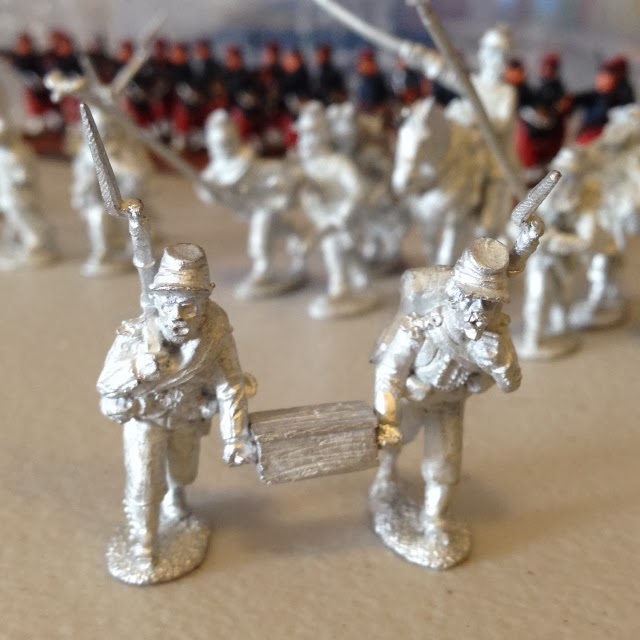
The FG MiniZ also produce casualties and a nice mounted officer. There is a drummer AND bugler available in addition to a nifty Ammunition Carrying party of two figures, (See Below)

The 14th Brooklyn is an interesting and colourful unit. They saw plenty of action and I'm glad I've got them in my collection.
OH!!! And I cant leave without mentioning a FANTASTIC Podcast that is a MUST for those of you interested in the American Civil War:
The CIVIL WAR (1861-1865: A HISTORY PODCAST


 It's EXTREAMLY informative and entertaining.
I highly recommend a listen.